
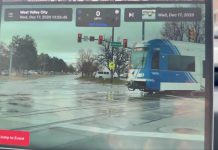
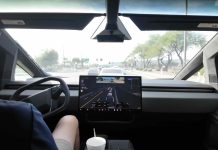




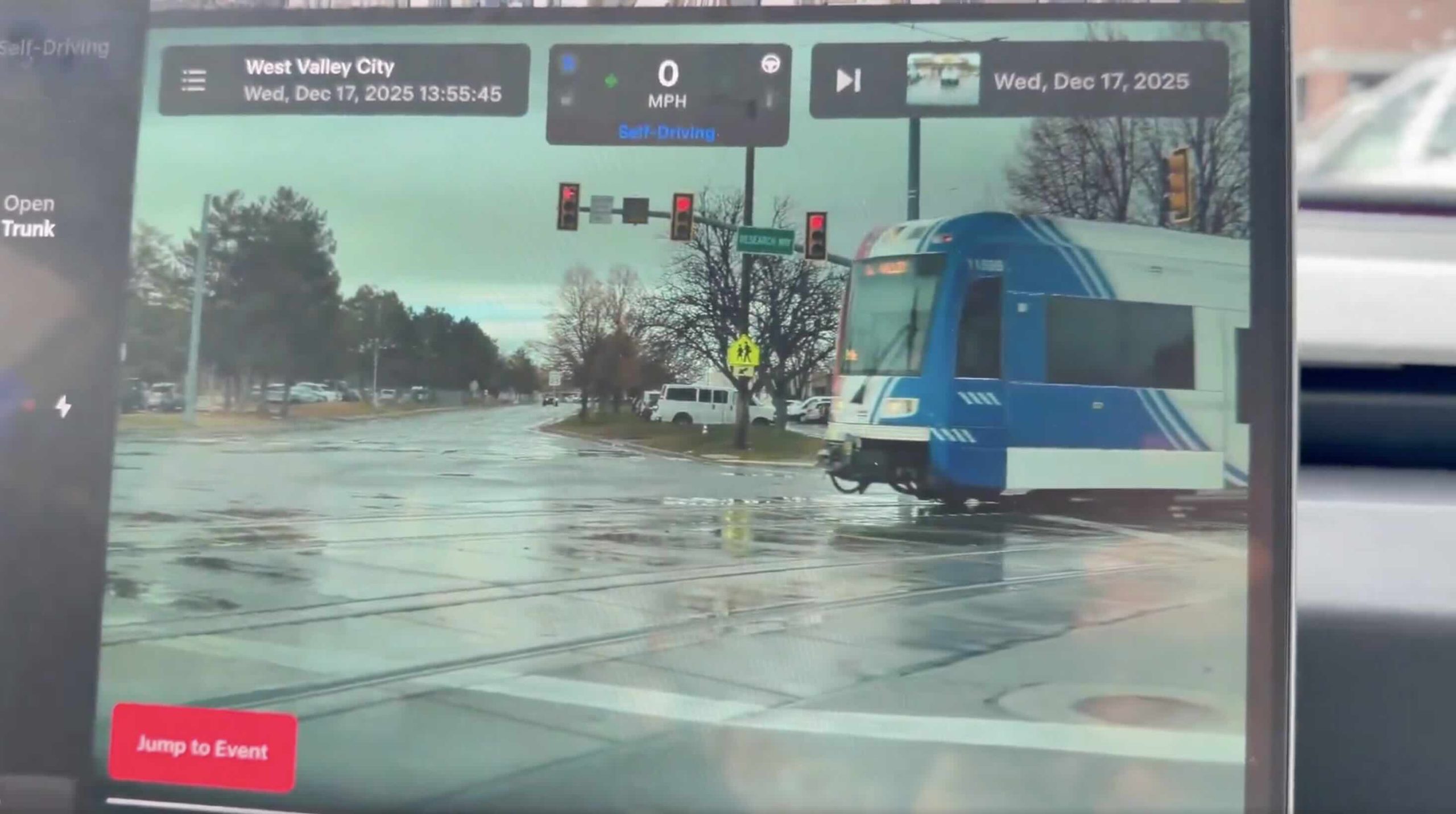
Tesla’s Full Self-Driving (Supervised) technology is again in the news following a highly dramatic real-life event involving version v14.2.1.25. As per recorded dashcam footage, one of Tesla’s cars signaled an oncoming train, braked fiercely, and reversed in a few seconds to create space, but the driver was not even fully aware of what was going on.
The response was swift, firm, and unexpected. The driver says that the car had already moved in reverse before they could comprehend what was happening. To most viewers, this action underlined the extent to which Tesla’s AI-driven driving stack has already advanced in terms of identifying threats and performing evasive actions when needed.
What Exactly Happened?
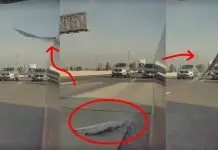
The accident happened at a railway crossing when the Tesla under FSD (Supervised) detected a train that was moving into the vehicle’s projected path. Instead of hesitating or waiting for driver input, the system slammed on the brakes and at once moved the car in a reverse motion to get more distance between it and the approaching train.
It is especially important as autonomous systems have difficulties with reversing. It is not a simple process. It involves a quick environmental check, ensuring that the back route is clear, and it involves confident execution- all within a quarter of a second. The promptness and fluidity of the response point to the fact that FSD v14.2.1.25 is beginning to make more human-like safety decisions, yet with machine-like response times.
Wow. FSD 14.2.1.25 hit the brakes really hard and reversed to make way for a train. 👍👍 pic.twitter.com/lqa5e5ZHpa
— Lincoln (@MobofJoggers) December 17, 2025
Why This Moment Matters
One of the most hazardous intersections for drivers is a train crossing. The trains cannot be brought to a stop easily, and at times the signals are misread and the human drivers panic or freeze. Here, the FSD system of Tesla did what safety professionals tend to advise, and humans find difficult to do when stressed: take immediate action and decisively.
The system did not simply halt; on the contrary, it made more space. The fact that proactive behavior is more than simple obstacle detection suggests higher-level situational awareness. To most Tesla owners and those watching autonomy, this act is a preview of what a near-Level 4 would resemble in particular situations.
The speed with which FSD switched gears to reverse was also one of the most breathtaking parts of the incident. Shifting, braking, and steering were done in a smooth manner. The response of the driver, who was astonished at the speed of the system response, highlights the disparities between the speed of human perception and the response time of AI-based automation.
The neural network method implemented by Tesla, trained on billions of miles of actual driving data, seems to be getting its own way in edge cases such as this one. Spotting a train, knowing its course, and deciding to reverse it is layered reasoning that involves handling a train given the serious constraints of time.