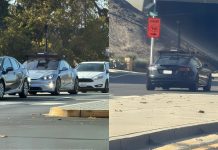


This is the first sighting of two Tesla Model S sedans with a wide array of validation hardware tooling on public roads within California. It is a significant change on the part of Tesla, since the company has been using the Model Y as the most universally applied test model for testing new hardware and gathering real-world data.
The sightings with the silver Model S and the black one include distinctive roof-mounted rigs, which prompted much guessing on the further significant actions of Tesla in the Full Self-Driving (FSD) evolution and autonomous-vehicle development.

A New Test Platform Emerges
To date, Tesla validation vehicles have been exclusively Model Y, as they are the vehicle with mass-market application and the high prevalence in the global Tesla fleet. The move to implement the Model S in this capacity is peculiar and notable. Tesla Model S is its flagship sedan, which is bigger, more powerful, and more expensive in terms of internal systems, and is an appropriate choice to test experimental hardware that might need more power, cooling, or space.
Two Model S vehicles spotted in California with the same validation rig that Tesla has been using on their Model Y’s all over the U.S. pic.twitter.com/7WhC7OrhEY
— Sawyer Merritt (@SawyerMerritt) December 11, 2025
The two spotted Model S cars have California manufacturer plates and have an ornate sensor apparatus on the roof. The system consists of a tall central mast and several peripheral devices, which are similar to lidar, high-precision radar, and reference-grade cameras that are often employed in autonomous-vehicle benchmarking.
Even though Tesla has often boasted of a camera-only FSD solution, the company has internally used lidar and other sensors to guide and test its neural-network training data.
What These New Sensors Could Mean
The massive sensor mast is a big sign that Tesla is in high-fidelity ground-truthing, a technique that is applied to gather highly accurate environmental information. These rigs aren’t designed for consumer use; they belong to a more sophisticated validation workflow. The Waymo and Cruise companies consist of similar equipment, mapping, and reference measures that aid in optimizing the perception systems.
Historically, Tesla has not used HD maps and intensive sensor fusion, but the emergence of these Model S testbeds suggests an extension of this validation procedure or a test to accelerate the accuracy of FSD. Model S, which has a larger chassis and more powerful electrical foundation, is better suited to experimental compute modules and large calibration systems than the Model Y.
Greater Significance on FSD Development
The decision to include the Model S in the testing fleet of Tesla can be an indication of several changes:
- FSD hardware – A new generation of FSD hardware, Tesla might be experimenting with the post-HW4 or HW5 hardware, with the Model S serving as the ideal testing ground.
- Combined validation program – As robotaxi goals speed up, Tesla could be making sure that future autonomous behavior will be validated in a variety of vehicles, including not just the Model Y.
- More focus on accuracy in data gathering – The sensor rigs suggest that Tesla is augmenting fleet training data with controlled high-fidelity data to accelerate neural-network enhancements.
The observation of two distinct prototypes of the Model S also indicates that it is not a pilot project but rather a well-organized system of cars and test tracks.