


It is not an easy task to navigate Europe’s narrow streets, centuries-old roadways, even for most skilled human drivers. France, especially, is characterized by the small village streets, turns, and the circumstances under which drivers often have to negotiate with the traffic. In a more recent real-life trial, the Full Self-Driving (Supervised) system of Tesla displayed spectacular abilities in managing one of such difficult environments with remarkable calm and accurate precision. The situation had a range of tricky maneuvers, and the Tesla system was able to perform them without any interventions.
A Narrow Two-Way Street in France: The Ultimate Real-World Test
Europe’s older town roadways are known to pose a challenging environment to autonomous systems. The lane markings can be vague or absent, traffic is unpredictable, and the space available can be less than current standards. It is not only that computers find it hard in these environments, but most human drivers are also stressed in these environments.
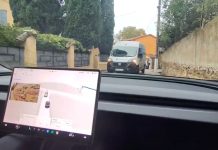
Tesla FSD Supervised on very narrow streets in France with oncoming traffic. Backs up to go around a tight corner. No interventions. pic.twitter.com/7J2k1XybgY
— Jonas Wustrack (@JonasWustrack) December 3, 2025
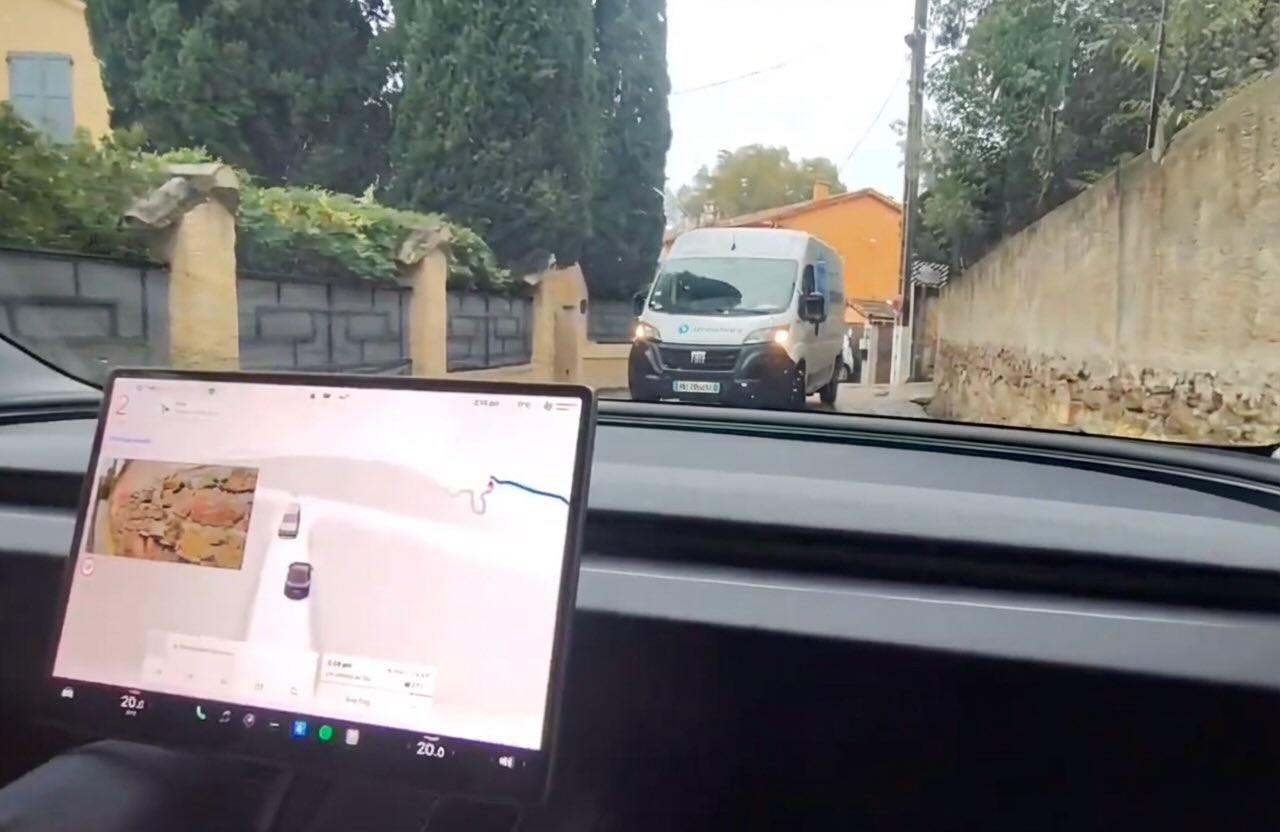
In the recently recorded video, a Tesla FSD (Supervised) came across a very narrow road with two lanes, and only one car could pass by realistically. A coming delivery truck was in sight, and there was not much space in which both vehicles could maneuver.
The system assessed the situation as adequate, and then it slowed down, paused, and waited calmly as the delivery truck turned to provide ample space. This shows that the vehicle was aware that the space available was not enough to pass concurrently. The Tesla system acted as a polite and skilled driver, allowing the other vehicle to complete its maneuver.
Such interactions are infamously hard on autonomous systems, which are required to make sense of unstructured worlds and uncertain human behavior. Major advances in the Tesla neural-network-based driving strategy can be seen in the fact that FSD managed the encounter in a fluid way.
Proceeding Through the Gap Without Hesitation
As soon as the delivery truck cleared the way, the Tesla proceeded with all the confidence. The most notable fact was the lack of hesitation or swinging back and forth, which was occasionally observed with the first type of driver-assist technology.
The car had a steady course, had the movements of its wheels even, and moved through an opening that was not more than a few inches larger than the vehicle. Such spatial accuracy underscores the maturity of the vision-based system developed by Tesla, which uses eight cameras and neural networks to be trained on millions of real-life cases.
To drivers, it will be much smoother and predictable, particularly in scenarios where indecisiveness may lead to traffic inconveniences or frustration.
Perhaps the most impressive part of the entire sequence was the last: the vehicle approached a narrow right turn that was too tight to navigate in a single forward motion. Detecting the limitation, FSD (Supervised) initiated a controlled reverse maneuver to realign itself before completing the turn. Reverse steering in tight quarters is typically one of the more challenging tasks for both humans and machines. The fact that Tesla handled it cleanly underscores how far the technology has come.